 UNMUL RECORDS CENTER
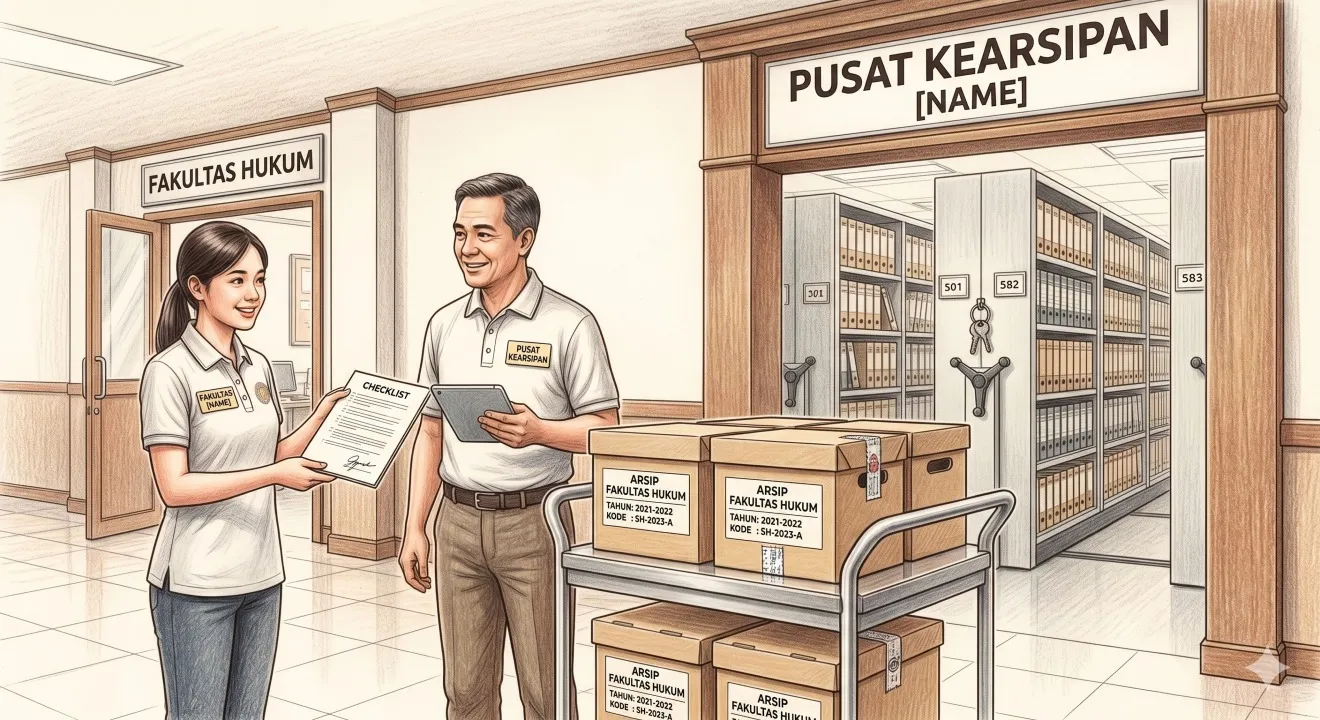
Moving documents can't just be carried in a box of instant noodles and dropped in front of the archive room door. There's an etiquette and procedure to keep the documents dignified (and of course, so you're not searched for again because of incomplete data).
Many people think that handing over archives is just a matter of moving things around. In reality, it’s a process of transferring legal responsibility. To avoid being labeled as “careless,” follow these professional steps below:
1. The “Sorting” Operation (Selection Is Key)
Don’t send every stack of paper on the faculty desk. Remember, the archives center isn’t a final dumping ground.
Do: Select documents whose retention period has expired at the faculty (usually after 2–5 years) but which must be permanently retained or classified as dynamically inactive.
Discard: Paper clips or rusty metal staples. Replace them with plastic clips or tie them with cloth string so the paper doesn’t get damaged by age.
2. Create a "Roadmap" (Archival Inventory List / DPA)
The archives center won’t know what’s inside your boxes if there’s no list. Create a neat Archive Inventory List (DPA).
The contents are simple: serial number, classification code, brief description of the records, year, and quantity.
Why is this necessary? So that if the faculty needs them again someday, they just need to mention the serial number. No need to unpack the entire storage room!
3. "User-Friendly" Containers
Use standard archive boxes (usually dark brown). Label the front of the box clearly with:
Faculty/Department of Origin.
Box Number.
Document Year Range.
4. The Sacred Ritual: The Handover Report (BAST)
This is the most important part to ensure the process is legally binding. The BAST serves as proof that responsibility for document security has been transferred.
This document is signed by two parties: the transferring party (Faculty) and the receiving party (Central Archives Unit).
Attach the DPA created in step 2 as an integral part of this BAST.
5. Utilize the Digital Channel (Srikandi)
Since we’re in the modern era, don’t forget to enter this transfer data into the Srikandi application. It features an archive transfer function that makes tracking more advanced. So, while the physical documents move, the digital data gets updated too!
Why Must It Be This Organized?
Besides meeting ANRI regulations, professional archival work reflects the quality of your faculty’s bureaucracy. Imagine how proud you’ll feel when the audit team arrives and you can show them a neatly organized handover document in seconds. It’s a professional flex!
Ready to execute the "Archive Relocation" this week?