S.Kom
Position
Information Technology Division
Employee Number
198902032025211058

In a university, the archivist's role is to make alumni aware of the institution's desire to document their unique student experiences, creating "time capsules" for every four-year journey.
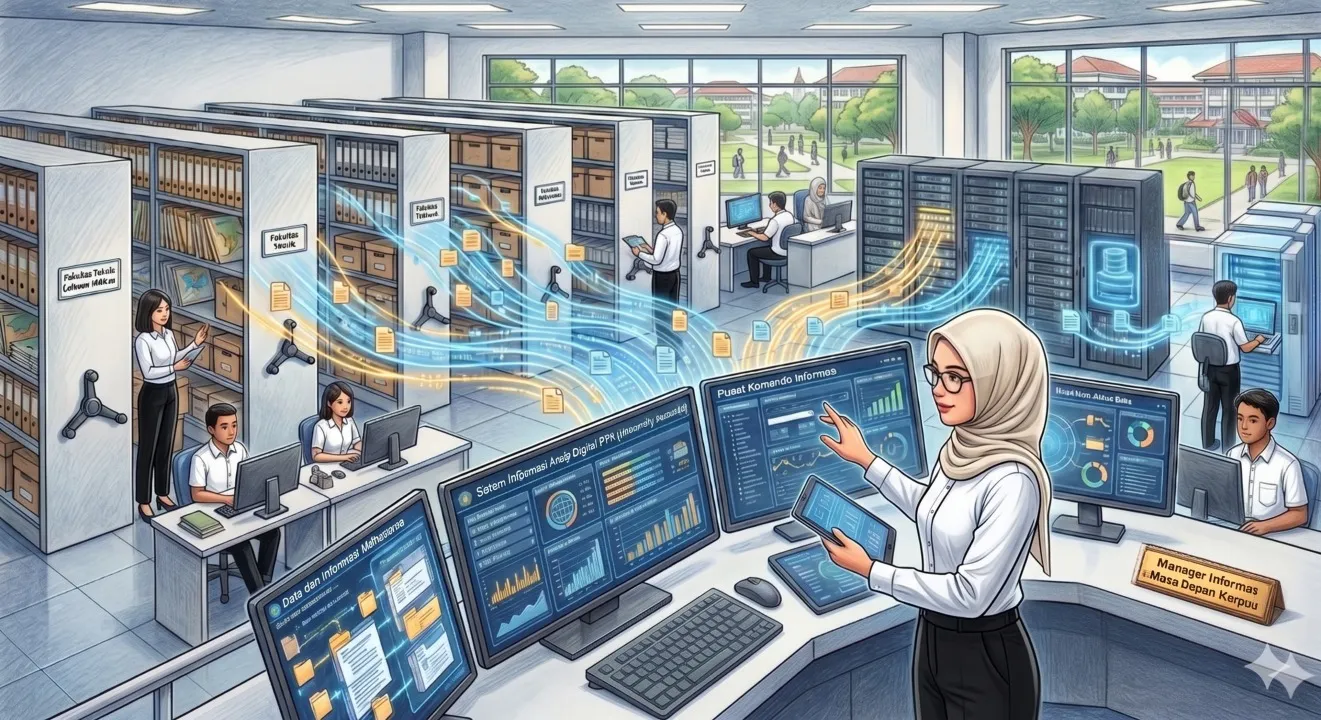
Have you ever heard it said in the office hallway that staff who are not performing well or are nearing retirement will be "dumped" into the archives? Or perhaps you often picture an archive officer as someone who sits in a dusty room, wears thick glasses, and is surrounded by stacks of old folders?
Read More →
Many Archivists work hard behind the scenes, but unfortunately are often "invisible" or only sought after when a document goes missing. In fact, your role is vital! Like a computer, you are the processor. Without you, data would slow down and crash.
Read More →GPA: 3.26
Thesis: Reinforcement Learning: Optimizing Autonomous Vehicle Navigation in Dynamic Urban Environments via Reinforcement Learning
GPA: 3.40
Thesis: Object-Oriented Programming Tutorial Website with Interactive Examples: An educational tool designed to test usability and learning outcomes.
GPA: 3.50
Disertation: Fairness-Aware Deep Learning Models for Dynamic Insurance Pricing: Focuses on identifying and mitigating biases in pricing models.
Manage costumer, make sure all computer in ready to use condition and client area clean.
Installation and Maintenance of Computer, Internet Networking and Surveillance Camera
Design Flyer, Brochure, and another marketing media
Amazon Web Services
2020
Microsoft
2023
IBM
2025
Journal of Computer and Techology
The widespread dissemination of misinformation on social media has created an urgent need for robust automated detection systems to preserve public trust and democratic stability. This thesis presents a comparative study of state-of-the-art transformer-based models—including BERT, RoBERTa, and DistilBERT—to evaluate their effectiveness in identifying fake news across diverse social media datasets. While traditional machine learning methods like SVM and Random Forest often struggle with the nuanced linguistic patterns and rapid evolution of online misinformation, transformer architectures leverage self-attention mechanisms to capture deep contextual relationships within text. Our methodology involves fine-tuning these models on benchmark datasets such as LIAR, ISOT, and FakeNewsNet, and evaluating their performance using metrics including accuracy, precision, recall, and F1-score. Preliminary findings indicate that RoBERTa consistently outperforms baseline models, often achieving F1-scores above 0.90 by effectively handling the informal and often noise-heavy language typical of platforms like Twitter and Facebook. Furthermore, this research investigates the role of explainability, demonstrating how attention weights can highlight deceptive keywords to enhance user trust. The results provide a framework for developing real-time, scalable detection tools capable of mitigating the impact of digital misinformation in modern information ecosystems. Key Terms: Natural Language Processing (NLP), Transformer Models, BERT, Fake News Detection, Social Media Analytics, Deep Learning.
Nick Bostrom
 UNMUL RECORDS CENTER